Showing posts with label science. Show all posts

Wednesday, January 25, 2017

Snapshot: 8A Barbie Bungee Jump


Students are always asking,"When will I ever use this?" in math class. I do my best to give them real world contexts for the skills they are learning. In the 8th grade, we began the year learning about linear functions and figuring out how to graph them. To help make these skills real, the students did an activity where they had to use linear functions to figure out how many rubber bands a Barbie required to get the most thrilling bungee jump off QLab 201's balcony (16 feet).  Thrilling was defined as getting as close to the ground without actually touching the ground.  Here is a compilation of shots from our jump day. 

Thank you to Blake Hansen for the video footage and editing.

To see more photos and videos and to read more about the project, see this blog post.

Wednesday, January 28, 2015

8th Graders win International Year of Crystallography Video Contest!

This morning, our Black Pine Circle work at the Advanced Light Source was featured in the ALS monthly newsletter.  


After a busy year of learning about x-rays, conducting experiments at the ALS, and even visiting the White House, some of the budding scientists from local middle school, Black Pine Circle, have created and submitted videos based on their experiments to the International Year of Crystallography 2014 USA/Canada Video Contest. Their work, showing the experiments they conducted on ALS Beamlines 12.2.2 and 8.3.2, can be seen here:

Voting on winning entries concluded December 31, we will let you know who won in the next issue.


Just a few moments later, the International Year of Crystallography video contest (open to K-12 Students in the USA and Canada) announced their winners!  Black Pine Circle students placed three times!  The Second Place award goes to Black Pine Circle School for Sam and Flynn’s video on their experiment at the ALS and Sam W’s (crystallization experiment) and Jane, Abe and Daniel (video on scanning paper samples at the ALS) all received honorable mentions!

You can visit the contest page view all the videos, or you can watch the ALS-specific videos embedded below!  Congrats to all the 8th graders who participated!


Scanning Paper Samples at the Advanced Light Source
Jane, Daniel, Abe


Our Crystallography Experiment at the Advanced Light Source
Sam & Flynn


Tuesday, April 15, 2014

Ducks in 7th Grade Science

(To be continued… this is just a draft 5.14.14) 
Embryology is an important part of life science. 

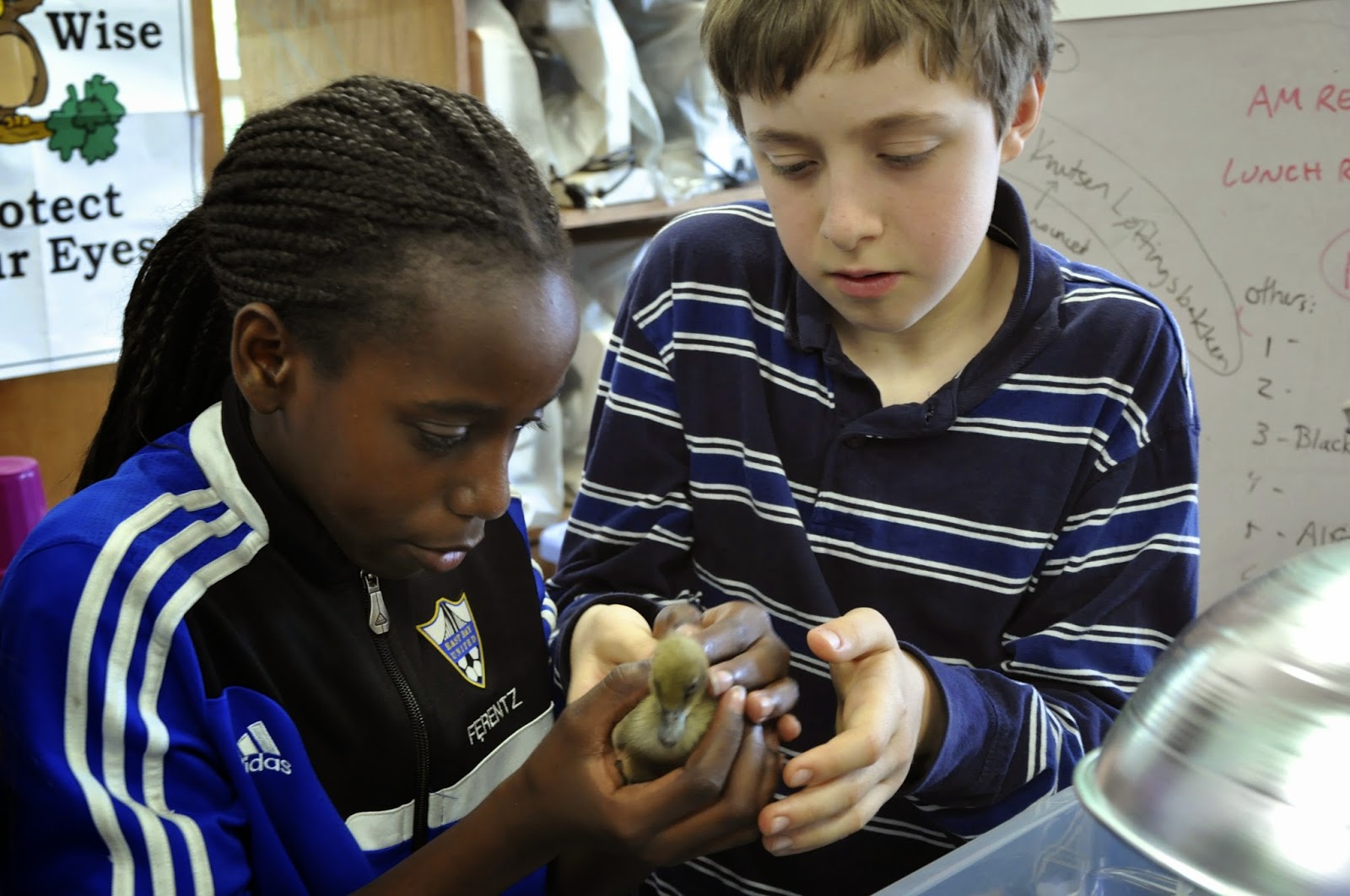
After 28 days of eager anticipation, six ducklings hatched.  They started off quite small.


At first, they used a paint tray for swimming.


As they got bigger, they graduated to a metal bucket. 


Finally, they were getting too big for their brooder… 


Finally, it was necessary to take drastic measures.


A final swim… 


Along the way, we enjoyed our time with the ducks.


Saturday, March 22, 2014

Cardboard Arcade using MaKey MaKey & Scratch

This beautiful video tells the story of Caine's Arcade.  Caine Monroy is a nine year old from Southern California who spent his summer vacation building a cardboard arcade inside his dad's used auto parts store.  He had a hard time getting anyone to play his games, until one day when Nirvan Mullick happened to walk in and buy a Fun Pass.


Recently, inspired by Caine and his arcade, BPC's 7th grade students designed, built, and shared their own cardboard arcade creations.  We were able to add a bit of technology to the challenge, using Scratch for programming and MaKey MaKeys to incorporate some simple circuitry and provide input to the Scratch program.  BPC students from grades K - 6 were invited to come over and play!

Here is a brief highlight reel.  You can read more about our project (including the lesson plans) on Mytko's Post-its and Ponderings blog post.


More photos:


Wednesday, February 12, 2014

SNAPSHOT: Virtual Field Trip to the Berkeley Lab via Google Hangout

Earlier this week, we learned that Berkeley Lab was hosting a "virtual field trip" on Google as part of a new series of Google+#connectedclassrooms hangouts at the National Labs.
Check out how our scientists use the Advanced Light Source to image microscopic life in 3-D. Tour a clean room at the Molecular Foundry, where scientists create nanoscale structures. And learn what’s possible with one of the world’s most powerful electron microscopes at the National Center for Electron Microscopy, which can see individual atoms. 
The three scientists featured included: Dula Parkinson (beamline scientist at the Advanced Light Source), Deirdre Olynick (staff scientist at the Molecular Foundry), and Jim Ciston (senior staff scientist at the National Center for Electron Microscopy).  We were especially excited to "revisit" with Dula Parkinson since he helped make our recent real-life field trip to the ALS happen!


Tuesday, February 4, 2014

7th Grade Visits The Cultured Pickle Shop!

This week, the 7th grade took a walking trip to The Cultured Pickle Shop.  This cool little shop is in West Berkeley and has been a passion for Alex Hozven and her husband, Kevin Farley, since 1997.  There were interviewed in 2010 in this Berkeleyside article.  They aim to create naturally fermented foods (no vinegar, water, or heat) like sauerkraut, kim chee, and kombucha with "a locavore sensibility and seasonal twist."

Photo reprinted with permission from Alex Hozven


We went to learn about the positive roles of microbes in food production and the process of fermentation.  We amassed interesting vocabulary words like zoogleal, SCOBY (various SCOBYs pictured right) and terroir!


The class split into two groups:

(1) one group learned about kombucha and asked general questions about microbes

(2) the other group went back and toured the pickling room full of fermentation vats!


I really enjoyed learning about how fermentation worked, and especially the containers for fermentation with the seals, and how important it was to keep them in an airless environment.  - Jane


We were grateful to The Cultured Pickle for sharing their shop with us and the kids made a big thank you card.  We also threw in a little BPC special: a 3D printed pickle! (pictured below)


And finally, a dramatic interpretation from Flynn:

Fade from black. Dramatic music plays. A high pitched scream is heard then, "IT'S COMING!!!" Footsteps. Suddenly, a gravely voice. "Ko- KOMBUCHA!!!" The footsteps get louder. A slurping sound is heard. "Yes.... VERY GOOD..." More screams are heard as other kombucha particles are sucked from their homes and are forced into the deep pit of the monster's stomach. No. Seriously. That kombucha was really good. Besides the wonderful tastes, I learned alot about the fermentation process. I was interested when I was told that their 'Classic Dill Pickles' are seasonal. Very interesting stu- SLUUURRPPP!! Ne- NEED MORE!!!

Saturday, December 7, 2013

BPC's 7th Grade Visits and Collects Data at the LBNL Advanced Light Source

This November, BPC's 7th grade had an unprecedented opportunity to visit the Advanced Light Source at Lawrence Berkeley National Lab and run experiments on the tomography beamline.  Students designed their own experiments, then collected data which will be brought back to the classroom where we will 3D print models of the reconstructed data.  The day of our trip to the ALS, all students participated in a half-day of instruction and tours, but only a subset of those students stayed in the afternoon to run their experiment as selected through a modified peer evaluation process. This process was based on the general user proposal process at the ALS and, through this process, students had a "real world" taste of how scientists must compete for scarce resources.  

UPDATE June 2014: We are thrilled to report that we successfully brought this project to the San Mateo Maker Faire AND the first-ever White House Maker Faire!


See more photos of our trip on our Flickr site


In this post, I'd like to describe five parts of this exciting opportunity:

  1. Inspiration for the Experience
  2. Trip Preparation
  3. The Proposal Process
  4. Field Trip to the ALS
  5. Data and 3D Printing Follow-Up

Inspiration

In the summer of 2013, I had the opportunity to participate in a 7-week IISME Fellowship.
Industry Initiatives for Science and Math Education (IISME) is a nonprofit, industry-education partnership whose mission is to empower and equip California teachers with unique professional development so that they can inspire their students to pursue science, technology, engineering and math (STEM) subjects and prepare them for today’s workforce in the global economy.
I was specifically interested in learning more about ways I could use 3D printing in the classroom for more than printing plastic trinkets.  Thanks to the gracious networking of the BPC parent community, I was connected with Dula Parkinson, tomography Beamline Scientist at the Advanced Light Source.  Through Dula's patience and mentoring, I learned a lot about xrays, synchrotrons, tomography, and data visualization.  As part of my IIMSE requirements, I also developed curriculum to bring what I learned back to my classroom.  I chose to develop this curriculum around the proposal process used by scientists hoping to use the tomography beamline for their own research.  You can view the curriculum here, if you are interested.

At the end of my summer experience, I also ended up with some models of my own scan data to share with students.  For example, I scanned a 2 mm long piece of Mentos candy shell, with the intent to print it large enough that students can visualize the nucleation sites, instead of merely learning about them in abstraction.  I have already printed a large model of a boiling chip.  One student, holding both the tiny boiling chip and the large 3D printed model mused, "Looking at this boiling chip, you would have no idea of how much detail there is at its surface!"  Exactly!  And, I published my first scientific poster, entitled Using X-Ray Imaging and 3D Printing to Create Macroscale Models of Microscale Structures.  (click on image to view larger version) which now hangs in my classroom, above the 3D printers, as inspiration.


Trip Preparation


In order to prepare for the trip, the students did some background research on the Advanced Light Source (you can view a public archive of our class page here) focusing on the criteria and constants of Beamline 8.3.2 - Tomography.


Criteria -  parameters
Constraints - limits
1. Sample is very small and 3-dimensional.
2. The sample has interesting features at the micro- (as opposed to nano- or macro- scale.)
1. The sample should be 100 µm to 70 mm
2. The imaged voxels (kind of like a 3D pixels) can be 0.9 - 19 microns or µm
3.  The sample needs to stay still while it is rotating.
4.  The sample cannot potentially spread a disease (safety consideration).
5.  Any wet samples need to be prepared so that they do not dry out from the xrays (and shrink while being imaged).


If you are interested, here is an overview of how Beamline 8.3.2 works, which describes the process the kids followed for collecting their own data.


Student worked in groups to brainstorm samples they would like to scan.  Dula, Beamline Scientist, made himself available via Google Docs during this time to answer students' questions.  I loved how he took all of their questions very seriously, yet answered in an age-appropriate way.  Here are some excerpts from this Doc.

Q. Will agar get destroyed in the x-rays? What do you  think is a good way to mount it? 
A. Agar should be fine. but you should make sure that it’s not too wiggly--make sure it’s a relatively stiff mixture. otherwise it will wobble around during the scanning and the images will look messed up. 
In general, you can just put things on a little pedestal we have (or into a drill chuck holder we have) and secure it with tape, glue, or clay. We’ve done living plants before (like grapevines, etc.), so we designed special plant holders that clamp the stems in place at the spot we image them. We can probably figure something out when you come, but it may involve cutting your sample into pieces.

Q. Can we scan the dried blood on my fingernail (no longer on my finger - it is in a baggie) that got smashed off in a door? Or will that spread disease?
UPDATE 11/18/13:  This is what the biological safety officer told me are the options for you to be able to do this. Sounds like it could work. “Umbrella BUA” means the Biological Use Authorization, which means you can bring it without doing anything special. 
1) If user can chemically fix (e.g. formalin, methanol etc) these samples, that would be perfect
2) If fixing interferes with the outcome of their experiment, then I would recommend only the user (the sample donor) -to directly handle these samples, so that there is no concern about exposure to anyone else.
3) If the tooth is free of blood and any tissue, then it is covered in the umbrella BUA
4) Wipe clean all the surfaces with "Caviwipes" where these samples were handled. 
Our biological use authorization says that biological samples have to be “fixed”. Usually that means you put the sample into some chemical that totally kills all living things. I’ll have to ask the safety officers about dried blood on a fingernail because I’m not sure. I emailed them and will let you know. I should mention that we are probably (as in almost for sure) not going to be able to see any single cells--our resolution and contrast just aren’t good enough for that.

Q. Would I have to prep the cricket before we scan it? 
A. The cricket should be fine to scan as-is. There are methods for “drying” the sample in a way that best preserves the internal structure, since if you just leave it dead in air for a while the insides might shrivel up such that the internal structure you image is not anything like the living animal. This involves putting it in a series of baths that have different percentages of ethanol (more and more ethanol in each bath), but I’ve never done it before myself. The other thing is that some internal structures can be seen better if you soak the cricket in a solution of KI (potassium iodide) before you scan. Some of the internals suck up iodine, which shows up better. It’s called a “contrast agent”, just like they make people drink stuff in the hospital before some CT or MRI or PET scans, so certain body parts show up better. But all of that only matters if you’re looking for a specific structure and need to see it better. Just scanning it as is will let you see the overall structures pretty well. 


Proposal Process


I introduced the proposal process by explaining to the students that
… the ALS is a valuable resource for scientists all over the world. It is funded by taxpayers, it costs 57.5 million dollars a year to operate, runs 24 hours a day, and is available for public use.  Beamtime is very precious, and often researchers will work straight through a 24 hours shift.  In fact, if an assigned scientist finishes up a 24-hour shift early, another researcher is often more than willing to pick up the “scraps,” even if it means coming in from 2am - 9am!   There is not enough beamtime to accommodate all who wish to use it.  This is why there is a proposal process in place.

Students then worked in teams to write proposals for their experiments.  Just like "real scientists," groups chose an Experimental Lead and Principal Investigator and worked to complete their Experiemental Safety Sheets and scientific support case.  Here are some student examples, with names removed: [Proposal 1 | Proposal 2]


All together, we proposed to scan: 3D printer filament, a contact lens, eyebrow hair, an eggshell, a tooth (with cavity), Indonesian volcanic tufa, dried blood on a fingernail, snakeskin, a cricket, a bird skull, agar, a butterfly wing, a pop rock, clear vs. duct tape, a fruit fly, and more.


These proposals were then scored through a peer editing process, using the same criteria used to evaluate beam time proposals for general users:


    • Scientific merit
    • Technical feasibility
    • Capability of the experimental group
    • Availability of the resources required


It was a difficult, but valuable, process and gave all of us an opportunity to empathize with scientists in the real-world who must write proposals to fund their research and get access to scarce resources.

Here are some student comments on the process:
"You learn a lot from just going to the ALS and the proposal process teaches you about how real life works.  Like how you may apply for a job but might not get it." 
"The proposals were kinda a life lesson that you can't always get what you want." 
"[Future classes] should certainly do the proposals because it will teach them how to do it in the future and if they become scientists, it'll be useful, even if their proposal is accepted, they'll learn that you don't always get to get in even with a great proposal. They'll also learn that sometimes life isn't fair." 
"I think that it was a supper fun learning experience at the ALS and I got a lot out of it. Even if you learn about these types of stuff in Science, it is better if you can actually visualize it at the ALS. Even though I my proposal didn't get it,  it was not only fun to write, but it teaches you that you have to try your hardest and in life, even if you do, sometimes things just don't work out but you just have to keep trying. "


Field Trip to the ALS


We had a total of 47 seventh grade students participate, so we had to stagger their participation as to not overwhelm the lab!  The day of the field trip(s), the students headed over to the lab and had a variety of experiences:

    • lectures on X-rays, diffraction and tomography
    • hands-on experience with diffraction demonstrations
    • time to use Avizo software to manipulate data in the data visualization room
    • a tour of the Advanced Light Source
    • more in-depth exploration of Beamline 8.3.2 - Tomography

After the trip, students were asked to describe a moment of the trip and chose a hashtag that best captured this moment.  Here are a selection of comments.  (Photos do not necessarily correspond to the author of the quote.)


"I remember where we were walking around the ALS and there were thousands of wires above us. And as we walked around the circle. There were offices where 1-3 people were doing different things. It was surprising how if you just cut one little wire a whole bunch of things could shut down." #thousandsofwires 
"When we first went down to the beamlines, I thought that it was very chaotic, and yet organized." #typicalberkeley 
"The room with the images of different scanned things-we were playing around with them, zooming in on them, going in them. Dula was there, and it was super fun because you could go in them and see the inner structures, in the case of the redwood and oak samples." #scancoolness 
"When we were picking out the perfect pop rock sample to scan with my group, Ms. Mytko and Dula. We had to use tweezers to get a very small sample and put it in the clay. It was challenging but very fun because we were doing real science that real scientists do." #scanningapoprockissuperduperamazing 
"I remember when I stayed extra and Dr. Padmore was talking to us about how you can make tremendous forces (equivalent to that underground). I remember we were talking to him about what we were going to scan and I was so happy that he was interested in our work." #bestfieldtripEVER


Here's a video the lab put together, touching on the students' experiences. :)


3D Printing Follow-Up


Finally, Dula took the x-ray images collected by the students and simplified them to manageable files sizes that we can bring back to our classroom.  These data sets come to us as "stacks" of the 2D images taken at the beamline.  We can use a data visualization program to reconstruct the images into 3D volumes, which can be converted to surfaces, and eventually to water-tight STL files that can be 3D printed. (ALS uses the Avizo software; we may have to make do with the less-powerful but free and open-source FIJI.) Over the next weeks and months, we hope to print these reconstructions, in order to visualize the data at a large scale.  (UPDATE 4.15.14 - one student has written up his process in converting tiff data into printable stl files.  And here is another post on the final eggshell print. To read the latest on our process, please visit our 3D printing / Maker Club blog posts labelled "ALSproject")

Here are some screen captures of our reconstructed data:


Agar


Duct Tape


Pop Rock


Snake Skin


Tooth


Eggshell


Final Thoughts


You can read more about our trip on the ALS news feature: Students Get a Taste of ALS User Experience or view more pictures in our ALS Flickr set.

Finally, I will leave you with some more quotes from the kids.


"That it was a great experience for our class to learn about advanced x-rays at the ALS where no other class has been before." 
"The ALS was an incredible experience. We learned a lot, and got to use professional beamline tools. I think that the seventh grade was greatly inspired by everything we did, and next year's will be too. Also, the proposals gave us a sense of what it's like to be a scientist in the real world and gave the whole thing a sense of fun competetiveness. We also got to learn about how to peer-review things in experimental groups. " 
"I think I learned  so much at the ALS and it was a once in a lifetime opportunity. We got to have insight on jobs in the professional science field and we got more information and demonstration which is great if  we want to pursue a career there when we get older (which I totally want to do now, it seems so fun and challenging!)" 
"I would say that this was important because not everybody has the opportunity to do this and by doing this it opens doors for students who hadn't had such an interest in science before, because in the classroom all we can do is see pictures and talk about it but when we actually got to go to the ALS we could be in actually DOING the science and that's how some people learn or get a bigger interest in it." 
"I was so inspired by this once-in-a-lifetime opportunity. Seeing and even using the tools, meeting the scientists... It gave me something to strive for, in a sense. Not necessarily the exact topic, but more the general vibe of the whole thing. Everyone there was laid back, but incredibly into their work, and eager to share it with the world. Every time someone walked by, I'd get a shiver up my spine thinking about the amazing science they were coming from working on. It made me want to be able to be like them, so confident and learned in their subjects, doing amazing experiments and research every day. Also, everyone was really helpful, especially Dula Parkinson, who organized the entire trip. I gave him a huge hug at the end :) He's awesome." 


Did the kids find this to be a useful experience?  It appears so, as evidenced by this data from a student post-trip survey.  


UPDATE 4.15.14: For your reading pleasure here are some things you might not know about particle accelerators! :)
UPDATE 4.19.14: When thinking about how to bring this experience to other classrooms, this open source CT scanner is intriguing!


Monday, September 16, 2013

Introducing our BPC Makerspace

Well, our first Maker Club sessions of the 2013-2014 school year seemed to be a success.  "Maker Mondays" are being successfully implemented into the science curriculum for the first time this year, picking up the slack from our recently dismantling-in-favor-of-integration technology program.

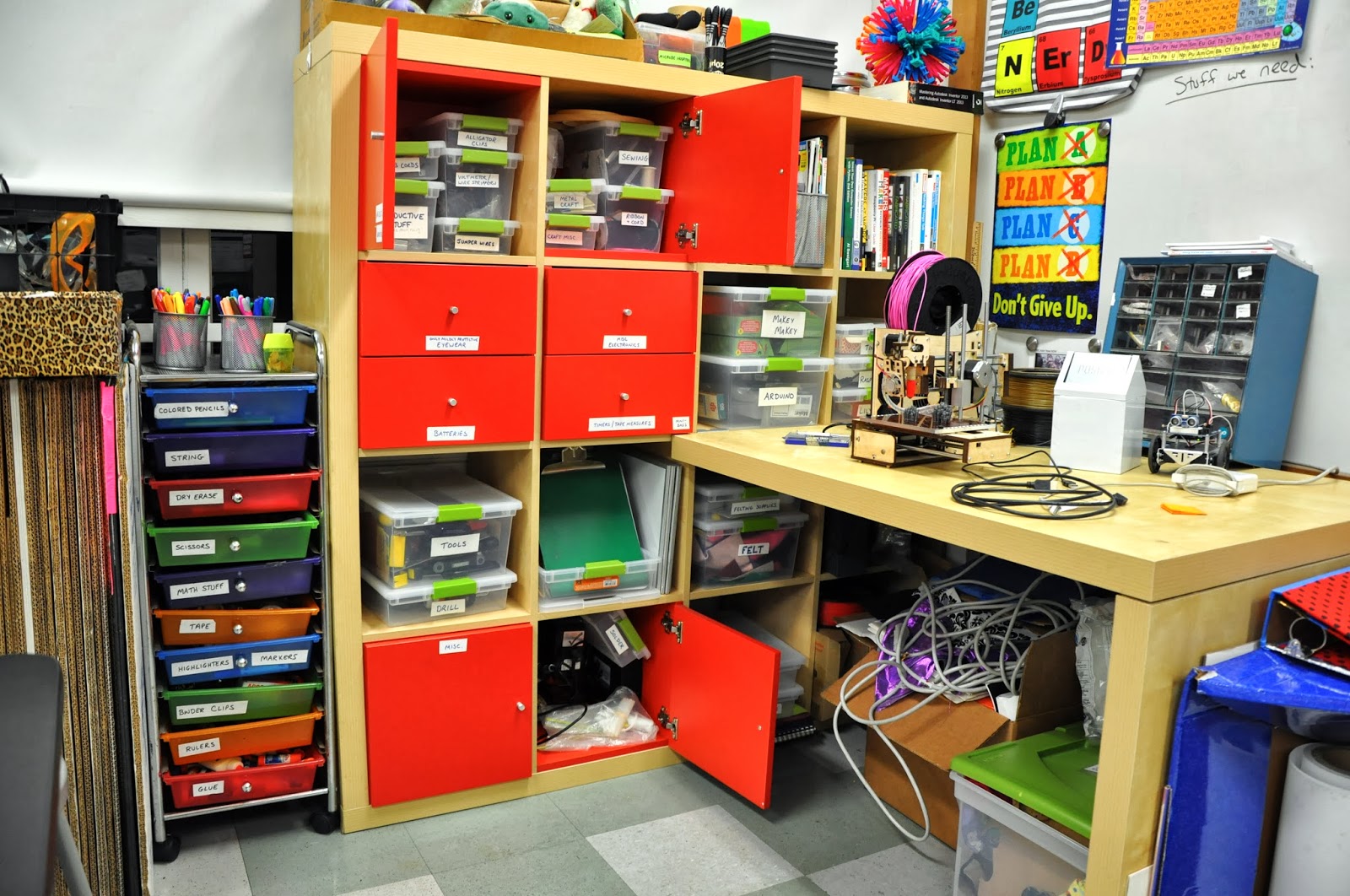
Our new classroom "Makerspace" (pictured to the left) is anchored by a new piece of furniture donated by my (Ms. Mytko's) roommate.  After weeks of combing local used office equipment spaces and other recycling establishments (like Urban Ore), I would have been thrilled with even a functional shelving unit.  But then this - with coordinating doors, drawers, and the desk - w00t!

If someone would have told me last year that I could fit this large additional piece of furniture in my classroom, I would have laughed.  To give you an idea, here is a picture (below) of the science classroom from the far back corner of the room.  It is not large by any means, and space is at a premium.  With 24 eighth graders in there, things can get pretty tight.  But, we figured out a way to make it work.


If you look to the far right of the picture, you might also see three 4-foot tables that I rescued from various spots from around the school.  After tightening some screws and lining them up, they represent our "design studio" with a couple of old laptops, our Makerbot* and our newest Printrbot*.  These tables, in addition to the shelving unit required us to push the lab tables even closer together.

But the loss of space due to the additional furniture was worth it, for it made a dedicated space for all of our tools.  We have a bin for MaKey MaKey*, Arduino*, Raspberry Pi* and a LilyPad*.  We also have drawers designated for batteries, safety glasses, duct tape, measuring tapes, sewing supplies*, felt* and timers.  We have shelves for our one set of Makedo*, books* (including my favorites!), Make Magazines*, a used Kinect scanner*, clipboards,  small dry erase boards for planning, and a bunch of items from a resale shop that we hope to eventually 3D scan.  We have a bin clearly marked "tools" and a designated space for the soldering iron* and glue guns.  There's even a bin labeled "raw materials" which hold cardboard and other assorted scraps for spontaneous making. And, of course, the "bucket of things you can take apart."

What is most interesting to me is that, besides the electronics equipment, most of these materials are new in my classroom.  What is new is their visibility and accessibility.  Before, these supplies lived in a bin or in some cabinet, only to be taken out by the teacher when part of an activity in the curriculum.  But now, students have been coming in on their free time and lunch periods to calibrate the Printrbot or expand on some idea they are working on with MaKey MaKey.  When some kid comments, "I think the gear is stuck," another student will respond by grabbing the pliers out of the tool bin, or when some kid lost the plastic scraper for our 3D printer, another kid jumped on Thingiverse, downloaded an stl file, and printed a replacement.  For the first time, students do not have to go through me to access the materials - they figure out what they need and know where to find it.  And they are starting to train each other how to use the various equipment, increasing their own buy-in, and decreasing the need for teacher direction!  It feels like a working space, and the kids are taking advantage of it.

Do I wish I had more space, time and resources for students to tinker and make things?  Absolutely.  But I knew I couldn't wait until I had the perfect space (and materials) to make that happen.  Instead I had to make the space - both physical and (more importantly) perceived.  I used to give all the credit to that shelving unit, but we're starting to realize that the shelf does far more than just hold the supplies, it helped shift the attitude from classroom to makerspace by keeping already existing tools visible and accessible, and empowering the kids to use them.


If you want to read more about the specifically 3D printing things we are up to, you can visit the blog I created with the kids: Tales of a 3D Printer.

UPDATE FEB 2014:  The kids have really taken to our Makerspace and it is used constantly during free periods and frequently during classes.  We are constantly adding to it as needs arise (ex: embroidery hoops for e-textiles, our 3Doodler, more bins, and lots and lots of cardboard and duct tape).  The visibility is definitely nurturing our making adventures this school year!


Sometimes I feel like our makerspace is slowly taking over our life science classroom!


Friday, August 30, 2013

Why STEAMspace?

Many of us in education are familiar with the acronym of STEM education - Science, Technology, Engineering, and Mathematics.  However, at Black Pine Circle, we were recently warmed up to a new acronym - STEAM - which includes an "A" for "Art & Design."


Now, this buzzword is not new (it's been around since at least 2006) but captures a particular nuance that illustrates our quirky Berkeley independent school, where science and art are equally important, well.  STEAM is a movement that came out of the Rhode Island School of Design (RISD) and, according to the STEM to STEAM website, aims to
  1. transform research policy to place Art + Design at the center of STEM
  2. encourage integration of Art + Design in K–20 education
  3. influence employers to hire artists and designers to drive innovation
The focus was put on STEM education many years ago, but to be truly competitive, it's about more than just math and science, it is about creativity and innovation; critical thinking and problem solving; and communication and collaboration.  It's about art & design.

This is excellent timing for us to embrace the idea of STEAM.  Over the summer of 2013, we dismantled our computer lab, moving technology into our library / media center space and into the classrooms, with the intent to integrate technology more widely within and across the curriculum.  In addition, in an effort to embrace the Engineering Design strand of the Next Generation Science Standards, we have implemented a Maker Mondays program in the 7th grade.

Regarding STEAM's predecessor STEM, some sources say the term STEM was first coined in the 1890's by the Committee of Ten at Harvard, as a response to the gaps in the agrarian school system of the 1800's.  Most credit the National Science Foundation in the early 1990s.  Other sources point to Dr. Judith Ramaley, president of Winona State University in Minnesota, who is said to have coined the term "STEM" when she was assistant director of the education and human resources directorate at the National Science Foundation from 2001 to 2004. (Previous to her, apparently the acronym was "SMET." Ew.) Other folks would prefer to discard the acronym altogether.

Whatever you prefer to call it, we will be highlighting some of the science, math, engineering, technology, and design happenings at BPC in this STEAMspace blog.

__________________________________________________________________

Other STEAM articles of interest:


Finally, here is a list of other organizations with STEAMspaces, although we were the first that we knew of (except, of course, for the gaming platform).  Know of others?  Please let us know!